
Confession time: I used to think exercise balls were just those giant bouncy things gathering dust in the corner of the gym. Maybe you’d see someone occasionally sitting on one instead of a bench, but otherwise, what was the point?
Boy, was I wrong. After incorporating an exercise ball into my routine, I’ve discovered it’s one of the most versatile, effective, and honestly fun pieces of fitness equipment you can own. And the best part? You can get a quality one for under $30.
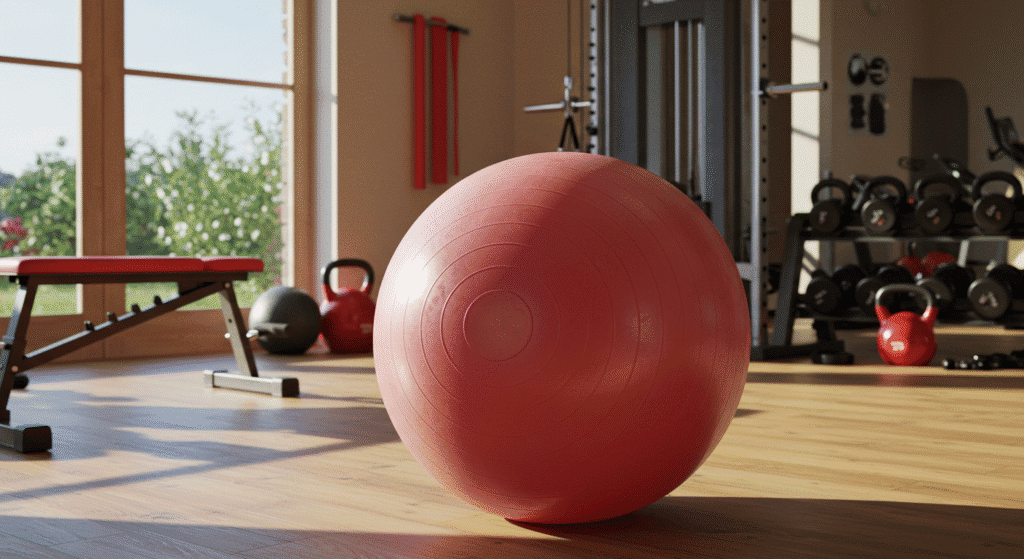
Whether you call it a stability ball, Swiss ball, or fitness ball, this simple sphere can transform your home workouts by challenging your balance, engaging your core in ways a flat surface never could, and providing modifications for exercises that might otherwise be too difficult or too easy.
So if you’re looking to shake up your fitness routine, improve your core strength, or add an effective but low-impact element to your home gym, you’re in the right place. Let’s roll into everything you need to know about exercise ball workouts.
Why Exercise Ball Workouts Are a Game-Changer for Women
The exercise ball isn’t just another fitness trend—it offers specific benefits that make it particularly valuable for women’s fitness goals and needs:
Core strength development happens almost automatically with exercise ball workouts because the unstable surface engages your deep stabilizing muscles just to maintain position. This strengthens not just the visible “six-pack” muscles but the deeper transverse abdominis that helps support your spine and internal organs.
Pelvic floor engagement occurs naturally during many exercise ball movements, which can help maintain or restore strength in these muscles that often weaken after pregnancy or with age. While not a replacement for dedicated pelvic floor exercises, the ball adds an extra dimension of support.
Pregnancy-friendly modifications are possible with an exercise ball when other workout equipment becomes uncomfortable or unsafe. Many prenatal fitness specialists recommend the ball for comfort and support during various stages of pregnancy.
Low-impact options abound with exercise ball workouts, making them ideal for women with joint issues or those recovering from injuries. You can get an intense workout without the harsh impact of jumping or running.
Posture improvement comes from the core engagement and back strengthening that proper exercise ball use promotes—counteracting the effects of desk jobs, carrying children, or other activities that can lead to rounded shoulders or hunched positions.
Beyond these specific benefits, the exercise ball is incredibly versatile, allowing you to progress or modify exercises based on your current fitness level—making it perfect for beginners and advanced athletes alike.
Choosing the Right Exercise Ball for Your Workouts
Before diving into the workouts, you need to make sure you have the right ball for your height and needs:
Size matters when it comes to exercise balls. When sitting on the ball, your knees should form a 90-degree angle with your feet flat on the floor. As a general guideline:
- If you’re under 5’2″: Use a 55cm ball
- If you’re 5’2″ to 5’8″: Use a 65cm ball
- If you’re over 5’8″: Use a 75cm ball
Material quality affects both safety and longevity. Look for “burst-resistant” or “anti-burst” labels, which mean the ball won’t explode if punctured but will slowly deflate instead. The Trideer Exercise Ball and URBNFit Exercise Ball both offer good quality at reasonable prices.
Weight capacity varies between balls. Most quality balls support at least 300 pounds, but if you plan to add weights to your ball exercises, choose one with a higher capacity, like the 2,000-pound capacity Dynapro Exercise Ball.
Texture differences can affect your workout experience. Some balls have a smooth surface, while others feature a tactile pattern that provides better grip, especially when you start to sweat. The latter is particularly useful for more dynamic exercises.
Pump options matter for convenience. Most balls come with a pump, but some are more effective than others. Hand pumps work fine but take longer; foot pumps make inflation much quicker.
Once you’ve selected your ball, inflate it to the point where you can press your thumb about half an inch into the surface. A properly inflated ball provides the right balance of support and give for effective workouts.
Essential Exercise Ball Moves for Beginners
If you’re new to using an exercise ball, start with these fundamental moves to develop your balance and familiarity with the ball:
Basic Seated Balance
Simply sitting on the ball might seem too easy, but it’s an excellent way to develop core awareness and improve posture. Sit centered on the ball with feet flat on the floor, hip-width apart. Draw your navel toward your spine, relax your shoulders, and engage your core. Try to maintain this position for 1-2 minutes, focusing on proper alignment.
Once this becomes easy, try lifting one foot slightly off the floor for 10-15 seconds, then switch sides. This simple progression significantly increases the challenge to your stabilizing muscles.
Wall Squats with Ball Support
Position the exercise ball between your mid-back and a wall. Place your feet hip-width apart, slightly in front of your body. Keep your weight in your heels as you slowly bend your knees to lower into a squat position, using the ball to roll with you along the wall.
Aim to get your thighs parallel to the floor, but go only as low as is comfortable with good form. Push through your heels to return to standing. Start with 10-12 repetitions, focusing on smooth, controlled movement.
Bridge with Heels on Ball
Lie on your back with your heels and calves resting on top of the ball, arms by your sides, palms down. Engage your core and squeeze your glutes to lift your hips toward the ceiling until your body forms a straight line from shoulders to heels.
Hold for 2-3 seconds at the top, then lower with control. Begin with 10 repetitions, adding more as your strength improves. This exercise strengthens your hamstrings, glutes, and core while introducing the instability element of the ball.
Ball Plank
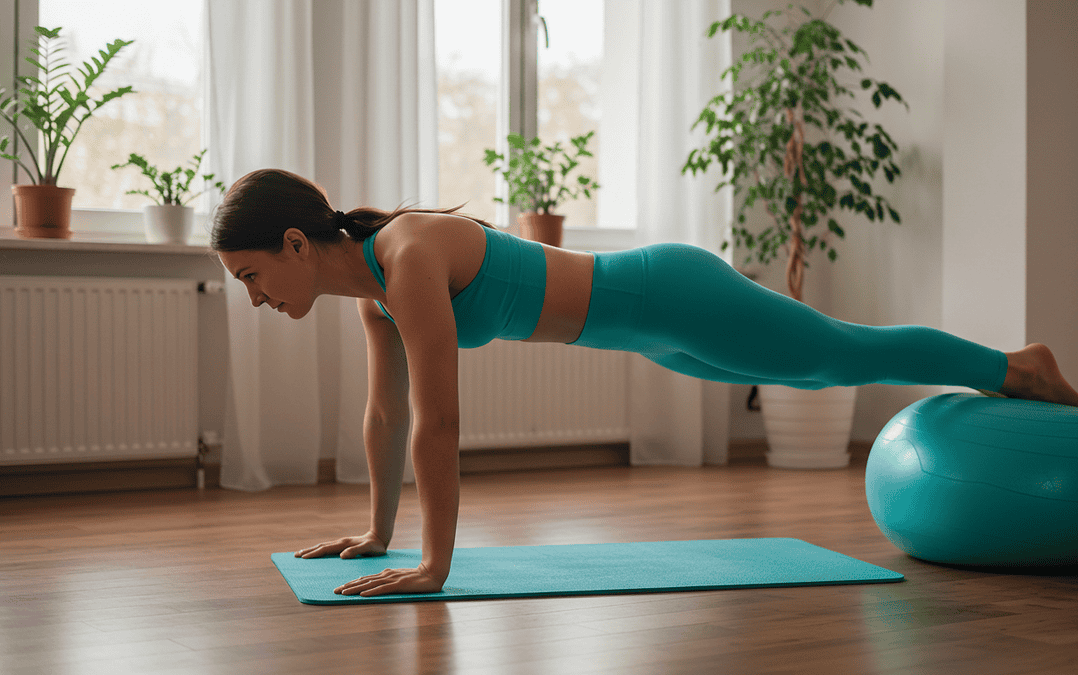
This beginner-friendly plank variation lets you practice core stability with the added challenge of the ball. Start on your knees with your forearms and elbows on the ball, hands clasped. Walk your knees back until your body forms a straight line from head to knees.
Hold this position for 20-30 seconds, focusing on keeping your core engaged and back flat—no sagging or hiking of the hips. As you get stronger, you can progress to a full plank with toes on the floor.
Seated Ball Marches
Sit centered on the ball with good posture, feet flat on the floor. Slowly lift one foot a few inches off the floor, hold for 2-3 seconds, then lower and repeat with the other foot. The goal is to maintain your balance and position on the ball without shifting side to side.
Start with 10 marches on each side, focusing on stability rather than speed. This move strengthens your deep core muscles and improves the brain-body connection needed for more advanced exercises.
Remember, mastering these basics builds the foundation for more challenging moves. Spend at least a few sessions getting comfortable with these exercises before progressing.
Core-Focused Exercise Ball Workouts That Actually Work
The exercise ball truly shines when it comes to core training, offering exercises that engage multiple muscle groups simultaneously for efficient, effective workouts:
Ball Crunches with Proper Form
Sit on the ball and walk your feet forward, allowing the ball to roll under your back until it supports your mid-back region. Place your hands lightly behind your head, elbows wide, feet flat on the floor hip-width apart.
Engage your core and lift your chest toward the ceiling in a crunch movement, focusing on the contraction in your abdominals. Lower with control and repeat for 12-15 repetitions.
The key difference from floor crunches is the extended range of motion the ball allows—you can lean back slightly farther, then crunch up higher, engaging more muscle fibers throughout the movement.
Ball Pass (Ab Pass)
Lie on your back with the exercise ball held between your hands above your head, legs extended. Simultaneously lift your arms and legs, passing the ball from your hands to between your ankles at the midpoint. Lower both arms and legs, then repeat the movement to pass the ball back to your hands.
This functional exercise strengthens the entire core, with emphasis on the lower abdominals that are often difficult to target effectively. Start with 8-10 passes in each direction.
Ball Roll-Out
Kneel behind the ball with your forearms resting on top of it, hands clasped. Keeping your core tight and back flat, slowly roll the ball forward, extending your arms and lowering your chest toward the floor until you feel a strong core engagement.
Use your abdominals to pull the ball back to the starting position. Begin with 8-10 controlled repetitions. This exercise mimics the ab wheel roll-out but with more scalable difficulty and less stress on the lower back.
Russian Twists on the Ball
Sit on the ball and walk your feet forward until the ball supports your mid-back, just like for crunches. Extend your arms straight in front of your chest, hands together.
Keeping your hips stable, rotate your upper body to one side, then to the other, moving through your obliques. For added challenge, hold a light weight or medicine ball. Start with 10-12 rotations to each side.
The unstable surface of the ball increases the demand on your obliques and deep stabilizing muscles compared to performing this exercise on the floor.
Plank Knee Tucks
Start in a plank position with your shins on the ball, hands directly under your shoulders on the floor. Your body should form a straight line from head to heels.
Keeping your core engaged, use your abdominals to pull your knees toward your chest, rolling the ball forward with your shins. Extend back to the starting position with control. Aim for 10-12 repetitions.
This dynamic exercise combines the stability challenge of a plank with the active flexion of the hip, creating a comprehensive core workout that also engages your shoulders and upper body.
For a complete core workout, perform 2-3 sets of each of these exercises with minimal rest between moves. As you progress, you can increase repetitions or add resistance where appropriate.
Full-Body Exercise Ball Workout Routine
While the core benefits are well-known, an exercise ball can provide an effective full-body workout that targets multiple muscle groups simultaneously:
Lower Body Focus
Ball Wall Squats: As described in the beginner section, but progress by holding weights or extending the time at the bottom of the squat. Targets quadriceps, hamstrings, and glutes.
Hamstring Curls: Lie on your back with heels on the ball, hips lifted in a bridge position. Use your hamstrings to curl the ball toward your glutes, then control it back to the starting position. Perform 12-15 repetitions for 3 sets.
Single-Leg Bridge: Similar to the basic bridge, but with one foot on the ball and the other leg extended straight up. This increases the challenge to your stabilizing muscles while focusing on the working leg’s glute and hamstring. Do 10-12 repetitions per leg.
Ball Lunges: Place the top of one foot on the ball behind you, then lower into a lunge position. The instability creates greater demand on your balance and core while working the front leg’s quadriceps and glute. Perform 10-12 repetitions per leg.
Upper Body Challenges
Incline Push-ups: Place your hands on the ball and extend your legs behind you in a plank position. Lower your chest toward the ball, then push back up. The unstable surface intensifies the challenge to your chest, shoulders, and triceps. Start with 8-10 repetitions and build up.
Ball Push-up Transfers: Begin in a plank position with both hands on the ball. Shift your weight to one hand, then place the other on the floor beside the ball. Continue transferring both hands to the floor, then back onto the ball in the opposite direction. This demanding exercise works your chest, shoulders, triceps, and core stability. Start with 3-5 transfers each direction.
Back Extensions: Lie face down over the ball with feet against a wall or heavy furniture for stability. Place hands lightly behind your head and use your lower back muscles to lift your chest away from the ball, creating a slight extension in your spine. Lower with control and repeat for 12-15 repetitions. This exercise strengthens the often-neglected posterior chain.
Y-T-I Raises: Lie face down over the ball with feet anchored for stability. Perform three consecutive movements with your arms: a Y position overhead, a T position out to the sides, and an I position straight by your sides. This series targets the muscles between your shoulder blades that help maintain good posture. Perform 8-10 complete Y-T-I sequences.
Full-Body Integration
Ball Mountain Climbers: Begin in a plank position with shins on the ball. Alternately draw each knee toward your chest while maintaining the plank position. This dynamic exercise elevates your heart rate while working your core, shoulders, and hip flexors. Start with 30 seconds and build up to longer intervals.
Ball Pike: From a plank position with your shins on the ball, engage your core and lift your hips toward the ceiling, rolling the ball toward your hands. Return to the plank position with control. This challenging move works your shoulders, core, and builds posterior chain strength. Begin with 8-10 repetitions.
Ball Burpee: Stand holding the ball at chest height. Place the ball on the floor, jump back into a plank position with hands on the ball, perform a push-up if possible, jump feet back toward the ball, then stand and lift the ball overhead. This compound exercise provides a cardiovascular challenge while engaging multiple muscle groups. Start with 8-10 repetitions.
Jackknife: Begin in a push-up position with your shins on the ball. Simultaneously bend your knees and round your back, pulling the ball toward your hands while lifting your hips. Return to the starting position with control. This advanced move integrates core strength with upper body stability. Aim for 8-10 controlled repetitions.
To create a full workout, select 1-2 exercises from each category and perform 2-3 sets of each, with minimal rest between exercises and 60-90 seconds between sets. This approach provides a time-efficient, effective full-body session using just your exercise ball and body weight.
Combining Exercise Ball Workouts with Other Fitness Equipment
An exercise ball works brilliantly in combination with other fitness tools to create varied, challenging workouts:
Exercise Ball and Dumbbell Combinations
Hold lightweight dumbbells while performing seated exercises on the ball to add upper body work to your core stabilization. Bicep curls, overhead presses, and lateral raises on the ball create a balance challenge while strengthening your arms and shoulders.
Chest presses on the ball (lying with your upper back supported on the ball, feet flat on the floor, and a dumbbell in each hand) engage more stabilizing muscles than the same exercise on a workout bench for home sessions.
For an advanced move, try the dumbbell pullover on the ball: lie with your upper back supported on the ball, holding a single dumbbell with both hands extended overhead, then use your lats and chest to pull the weight in an arc until it’s above your chest.
Exercise Ball with Resistance Bands
Loop a resistance band under the ball while seated to add resistance to squats, making the ball stay in place while you perform the movement.
Anchor a band under one foot while seated on the ball to perform seated rows, bicep curls, or tricep extensions with the added challenge of maintaining balance.
For a challenging core exercise, loop a resistance band around a sturdy anchor point, hold the handles, and perform kneeling rollouts with your forearms on the ball—the band adds resistance to both the extension and the return movement.
Exercise Ball and Kettlebell Integration
Hold a kettlebell in the goblet position (at your chest) while performing wall squats with the ball for added resistance and core engagement.
Place one hand on the ball in a side plank position while performing kettlebell rows with your free hand for an intense core and upper back challenge.
For advanced users, carefully perform Turkish get-ups with one hand on the ball instead of the floor to increase the stability challenge of this already-comprehensive kettlebell exercise.
The key to successful equipment combinations is to start conservatively with weight and complexity, mastering the foundational movement patterns before adding variables. This approach prevents injury and ensures you’re getting the full benefit of each exercise.
Exercise Ball Workouts for Specific Goals
Different fitness objectives require different approaches to exercise ball training:
For Posture Improvement
Focus on exercises that strengthen the upper back and core while opening the chest, counteracting the forward slouch many of us develop from desk work and device use:
Ball Superman: Lie face down over the ball with feet anchored against a wall, extend arms overhead, and lift your chest, arms and legs simultaneously. Hold for 2-3 seconds and release. This strengthens the entire posterior chain.
Seated Ball Rows: Sit tall on the ball with a resistance band anchored in front of you. Maintain perfect posture while pulling the band toward your ribcage, squeezing your shoulder blades together. This targets the rhomboids and middle trapezius that support upright posture.
Ball Thoracic Extensions: Sit with the ball supporting your mid-back, hands behind your head, allowing a gentle extension over the ball to open your chest and improve thoracic spine mobility.
For Back Pain Relief
The exercise ball can be remarkably effective for alleviating and preventing back pain through gentle, supported movements:
Pelvic Tilts on the Ball: Sit centered on the ball and practice alternating between anterior and posterior pelvic tilts to improve lower back mobility and awareness.
Gentle Extension: Lie back over the ball, allowing it to support your spine while you open your arms to the sides. This passive position helps counteract the forward flexion of daily activities.
Ball Marches with Back Support: Lie with your upper back supported on the ball, feet flat on the floor. Maintain a table-top position with your torso while alternately lifting each foot a few inches off the ground, focusing on core stability and minimal movement in your lower back.
Remember that if you’re experiencing acute back pain, consult a healthcare professional before beginning any exercise program.
For Pregnancy and Postpartum
The exercise ball is a favorite tool for supporting women through pregnancy and recovery:
Seated Pelvic Tilts: A gentle way to maintain pelvic mobility and relieve lower back pressure common during pregnancy.
Ball Rotations: Sitting on the ball, place hands on hips and make small circles with your hips, gradually increasing the size of the circles as comfortable. This promotes hip mobility and can help with positioning for labor.
Wall Ball Squats: Using the ball between your back and the wall provides safe support for squatting movements throughout pregnancy, helping maintain lower body strength for labor and recovery.
Postpartum Core Rebuilding: After receiving medical clearance, gentle exercises like seated ball marches and static seated holds help reconnect with the deep core muscles affected by pregnancy.
Always consult with your healthcare provider before beginning or continuing exercise during pregnancy and postpartum periods.
Common Exercise Ball Mistakes and How to Avoid Them
To get the most from your exercise ball workouts while staying safe, avoid these common errors:
Using the wrong size ball leads to poor positioning and reduced effectiveness. Your knees should form a 90-degree angle when sitting on the ball with feet flat on the floor. If your knees are higher than your hips, the ball is too small; if they’re lower, it’s too large.
Incorrect inflation affects stability and support. You should be able to press your thumb about half an inch into a properly inflated ball. Too firm, and you lose some of the beneficial instability; too soft, and the ball won’t provide adequate support.
Poor posture during seated exercises negates many benefits. Focus on sitting tall with your core engaged, shoulders relaxed, and spine neutral. The tendency to slouch on the ball is common but counterproductive.
Bouncing or using momentum rather than control reduces effectiveness and increases injury risk. While the ball can add a dynamic element to workouts, exercises should be performed with deliberate control rather than relying on bounce or momentum.
Neglecting proper exercise progression can lead to frustration or injury. Master basic stability moves before attempting more advanced exercises. The exercise ball has a steeper learning curve than some equipment, but the benefits are worth the patience.
Forgetting to engage your core throughout movements is perhaps the most common mistake. The primary benefit of the ball is core activation—mentally connect with these muscles during every exercise, even those primarily targeting arms or legs.
Creating a Safe Workout Space for Exercise Ball Training
Since the ball introduces an element of instability, creating a safe environment is essential:
Clear adequate space around you—at least 3-4 feet in all directions—to allow for movement without colliding with furniture or walls. This becomes even more important for dynamic exercises where you might need to adjust position quickly.
Choose appropriate flooring that provides some cushion while remaining stable. Carpet, yoga mats, or exercise flooring are ideal; avoid slippery surfaces like hardwood or tile without a non-slip mat.
Check your ball regularly for signs of wear, particularly at seam lines or valve areas. Even anti-burst balls eventually wear out and should be replaced if showing signs of deterioration.
Keep the ball clean to prevent slipping due to sweat or oils. Wipe it down with a mild soap solution periodically, rinse thoroughly, and allow to dry completely before using.
For beginners or when trying new exercises, position yourself near a wall or sturdy furniture that can provide support if needed while you develop confidence with the ball’s movement.
Remove hazards from your workout area such as small objects that could cause punctures, sharp furniture corners, or items you might collide with if you momentarily lose balance.
Incorporating Exercise Ball Workouts into Your Weekly Routine
To maximize results while allowing for recovery, consider this approach to adding exercise ball workouts to your existing fitness routine:
Start with two dedicated ball workout sessions per week, focusing on mastering form and building the specific stabilizing muscles needed for ball exercises. Begin with 20-30 minute sessions until you develop comfort with the movements.
Use the ball as an enhancement to existing workouts by substituting one or two conventional exercises with their ball versions. For example, replace standard crunches with ball crunches, or traditional bench presses with ball chest presses.
Create a maintenance routine of 5-10 minutes of core-focused ball exercises that you can add to the end of any workout for consistent core training without dedicating entire sessions to it.
For active recovery days, gentle stretching and mobility work on the ball provides movement without intensity. Try child’s pose with the ball supporting your chest, or gentle thoracic extensions over the ball to decompress after intense training days.
Progress thoughtfully by adding one new, more challenging exercise each week rather than completely overhauling your routine. This allows for continuous improvement while maintaining good form and confidence.
Consider complementary activities like yoga or Pilates that similarly focus on core control and body awareness, creating synergy with your ball training through different movement patterns.
My Personal Experience with Exercise Ball Transformation
I’ll be honest—when I first started using an exercise ball, I felt awkward and uncoordinated. Just sitting on it without wobbling was challenging enough! But after a few consistent weeks of incorporating it into my routine, I noticed changes not just in my workouts but in everyday movements.
My core strength improved dramatically, which made everything from carrying groceries to playing with my kids easier. My posture, which had suffered from years at a desk job, began to correct itself as my back and core muscles strengthened.
But perhaps the biggest game-changer was pairing my exercise ball workouts with proper fitness attire that didn’t distract me or require constant adjustment. My REZYLE sports bras with their sewn-in pads that stay perfectly in place during even the most dynamic ball exercises made focusing on form so much easier. When you’re trying to maintain balance on an unstable surface, the last thing you need is to be constantly tugging at bunched-up pads or adjusting straps. Check them out on Amazon if you’re tired of being distracted by your workout gear when you should be focusing on your form.
The exercise ball has become my go-to for efficient home workouts when I can’t make it to the gym. With just this single piece of equipment and perhaps a pair of light dumbbells, I can get a complete, challenging workout that leaves me feeling stronger and more centered.
Final Thoughts: The Versatile Value of Exercise Ball Training
The exercise ball stands out in the fitness world for its remarkable combination of simplicity, affordability, and effectiveness. Few pieces of equipment offer such a wide range of applications—from gentle rehabilitation exercises to challenging advanced movements that humble even seasoned athletes.
What makes the ball particularly valuable is its inherent scalability. The same ball that provides supported, gentle movement for someone recovering from injury can deliver intense, advanced challenges for someone at peak fitness—it’s all in how you use it.
As our understanding of functional fitness continues to evolve, the exercise ball’s emphasis on core strength, stability, and proper movement patterns aligns perfectly with what we now know about effective training. It’s not about isolated muscle growth; it’s about integrated movement patterns that translate to real-world strength and capability.
So whether you’re setting up a home gym on a budget, looking to supplement your existing routine with core-focused training, or seeking low-impact options that still deliver results, the exercise ball deserves a prime spot in your fitness arsenal.
Pair it with comfortable, supportive workout wear (because nothing kills workout motivation faster than constantly adjusting uncomfortable gear), set aside just 20-30 minutes a few times a week, and you’ll be amazed at how this simple sphere can transform your fitness experience.
Ready to roll? Check out our other guides on workout essentials for more ways to enhance your fitness journey, or explore step counter options to track your progress beyond the ball.